
Woodterrill Wind Turbine
Providing local renewable energy for Devon
Repowering Project
Woodterrill Farm is preparing to submit a planning application to Torridge District Council for the proposed repowering of two existing wind turbine with a single turbine and other associated development on land at Woodterrill Farm, Hollocombe, Chulmleigh, EX18 7QF.
Repowering minimises impact on local wildlife and ecology through building on already developed land whilst continuing the supply of low carbon, sustainable energy more efficiently through updated technology.
The turbine would generate clean energy and reduce CO2 emissions, alongside supporting the sustainable practices of a local family-run business.
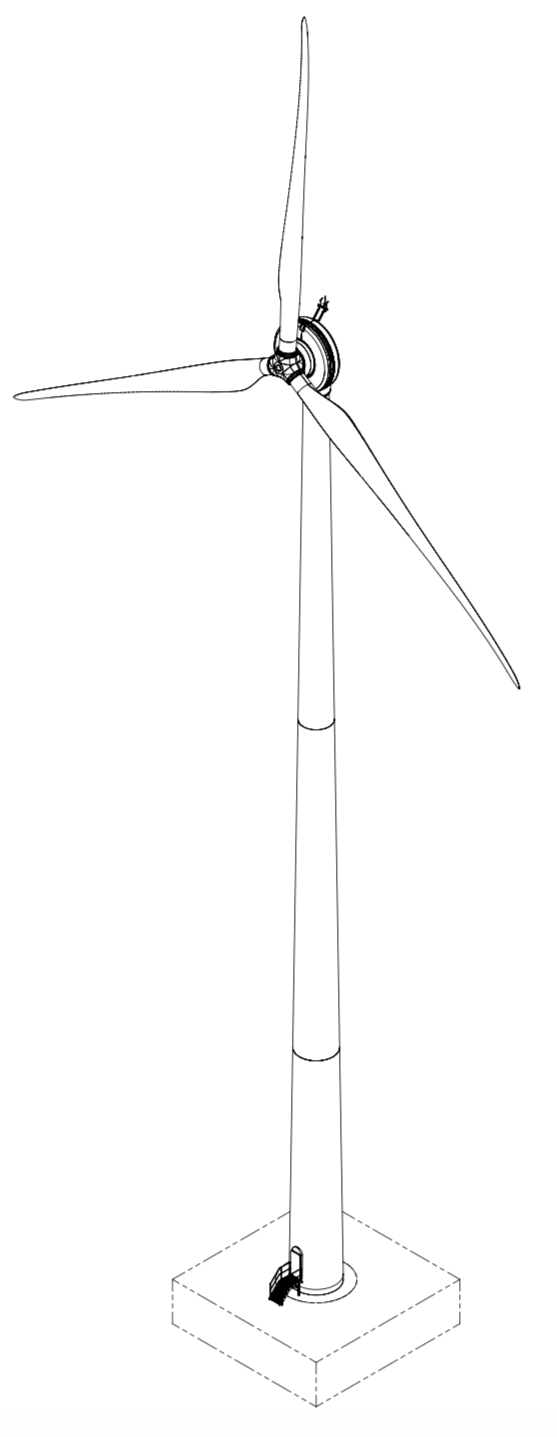
The proposed new turbine would comprise a tubular steel tower, with a hub height of 69 metres, supporting three blades, which have a tip height of 100 metres. This would replace the current turbines, which have a hub height of 30 metres and a tip height of 45 metres.
The new turbine is expected to generate approximately 1,500 MWh of electricity per year, more than trebling the existing renewable energy output at the site, at more than three times as much as with the previous infrastructure.
This would result in approximately 206 tonnes of CO₂ being saved additionally per annum, when compared with the existing turbine and electricity otherwise generated from fossil fuel sources.
-
The wind turns the blades of the turbine, and this energy is used by a generator located in a unit behind the turbine’s rotor, called a nacelle. The generator converts this energy into electricity. As the turbine is connected to the national grid, the electricity generated is fed into the grid network.
-
The turbine would be monitored remotely 24/7 and undergo regular maintenance inspections. All components would comply with international safety standards and access to the site will be controlled for public safety.
-
Modern turbines are designed to be quiet, with noise levels often being indistinguishable from background environmental sounds. Noise assessments are conducted as part of the planning process to ensure compliance with strict regulations.
-
We will be submitting a formal application for a period of operation of 40 years from the planning permission.
End-of-life decommissioning and any future site restoration would be secured via planning permissions, as we are applying for with this repowering planning application.
What are the benefits of repowering Woodterrill Wind Turbine?
The wind turbine will assist Torridge District Council’s aim for the district to become net zero carbon by 2050.
The project will deliver biodiversity net gains.
Woodterrill Wind Turbine are the owner and developer of this turbine. The project will therefore directly benefit the local economy and employment, alongside supporting sustainabile practices of a local, family-run business.
FAQs
-
National, regional and local policy recognises the role of renewable energy in responding to the climate and nature emergency. Onshore wind is widely recognised as one of the lowest-cost forms of new electricity generation. With electricity demand expected to grow significantly as transport and heating are electrified, increasing onshore wind capacity is essential to meeting climate targets alongside other renewable technologies. A balanced, coordinated approach to energy infrastructure is needed, combining onshore wind with solar, offshore wind, and energy storage.
The cost-of-living crisis, alongside rising energy prices and ongoing concerns about the UK’s energy security, means it is more important than ever to increase access to clean, reliable, and domestically generated electricity. Onshore wind plays a vital role in providing locally sourced renewable energy, helping to reduce dependence on fossil fuels while strengthening national resilience.
Expanding the UK’s onshore wind capacity reduces exposure to volatile global energy markets and helps ensure that Britain’s energy future is shaped at home. As a proven and established technology, onshore wind can be delivered quickly and at scale, supporting the transition to a low-carbon economy while improving long-term energy affordability and security.
-
Wind turbines are increasingly recyclable. Steel towers and copper components are already fully recyclable, and the industry is making rapid progress on composite blades - historically the most challenging component.
Major manufacturers are now deploying recyclable blade technologies at commercial scale, with some already installing fully recyclable blades and others targeting 100% recyclability by 2030.
At end-of-life, turbine materials can be recovered for reuse in new products rather than going to landfill. The technology and infrastructure for blade recycling is advancing quickly - by the time these turbines reach end-of-life, recycling will be standard practice.
-
Repowering minimises impact on local wildlife and ecology through building on already developed land. Ecological assessments have also been undertaken to capture any changes in land and wildlife conditions since the turbines were first developed.
-
Repowering is the process of upgrading or replacing aging wind turbines with newer, more powerful and efficient models. This can extend the life of sites by utilising existing infrastructure, grid connections and land.
-
The development is proposed to cover an area of 1.32 hectares (ha), which includes associated infrastructure such as the cable route.
The replacement turbine represents a significant upgrade in technology, producing more than three times more renewable energy on the same site footprint.
The turbine will provide locally generated electricity, reducing reliance on imported fossil fuels and contributing to greater energy independence for Devon.